Maurice and the Rats' Change
The Amazing Maurice and His Educated RodentsMaurice and the Rats' Change describes the sudden emergence of thought and self-awareness in Maurice and the rats, a transformation that overturns the boundary between an animal and a person. It begins with magical refuse discarded by the Wizards' University, but its significance lies not only in how the change happened. It also lies in what the changed beings make of their new minds: a moral limit on eating, a shared identity, and the difficult difference between a thinking community and a frightened mob.
The Change and Its Origins
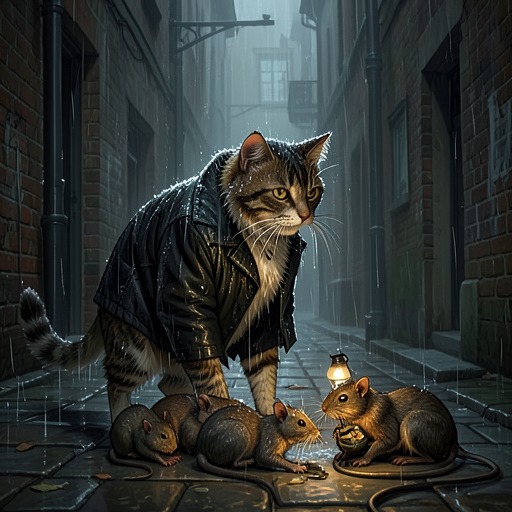
Maurice’s first remembered moment of self-awareness was ordinary in setting but radical in effect: just after lunch, he looked into a puddle and thought of the reflection as himself. Until then, his mind had seemed to him like a kind of soup. He could not clearly remember how he had thought before, but he knew that something had shifted. The discovery did not make him deliberately remarkable; he later understood that being amazing had simply happened to him.
The rats’ change is linked to what they ate. Their home and feeding place was a dump behind the Wizards' University, where discarded spell-books, candle stubs, and remains of bubbling cauldron mixtures were mixed with kitchen waste, tin cans, and old boxes. The wizards had put up warnings, but the rats could not read them then, and the discarded candle ends were food. Maurice, by contrast, remembered never eating from the dump and had adopted a practical rule against eating anything that glowed. For a time, that difference left the source of his own transformation unexplained: he had become intelligent at about the same time as the rats, although he had not eaten the magical refuse himself.
Maurice eventually identified the missing link in his own history. Before he could think, he had eaten a large rat with a bad leg, one missing ear, and a patch of white fur. That rat had consumed the magical material, and Maurice became changed after eating him. Maurice’s confession makes the transformation morally uncomfortable rather than simply miraculous: the being who later recognized that a talking creature could not be eaten had once eaten someone without knowing that he was a person. Maurice insisted that he had been only a cat and had not known; the memory nevertheless troubled him, including the remembered green and purple remains of the rat. The account explains the connection between the two changes while preserving the difference between unknowing animal appetite and the responsibilities Maurice acquired afterward.
Language, Identity, and Moral Limits
The rats’ new status first becomes unmistakable when one of them, Peaches, asks Maurice whether they can talk after he jumps on her. Maurice’s newly active mind supplies a limit: someone who can talk cannot simply be eaten, at least not before being heard. The rule changes his dealings with the rats. He begins spending time with them because they are companions he can speak with, and he has to remember not to eat any rat they know. His adjustment is practical as well as ethical: other cats now seem stupid to him, while the rats’ thoughts and company matter.
Their names offer another sign of the change. Dangerous Beans and the others have chosen names for themselves after learning to read labels and notices on rusty cans, sometimes before understanding all the words they have encountered. The names are not merely labels imposed from outside; they express an emerging ability to interpret language and construct an identity. Yet thinking also brings disagreement. Maurice finds Dangerous Beans’ thoughts about rats building a country difficult to dismiss, and Peaches is harder still to confuse with his usual fast talking. The change therefore produces more than speech: it gives the rats ideas Maurice cannot simply steer away.
Dangerous Beans gives this new identity a public form through fire. Hamnpork distrusts the flame, recalling the safety of darkness and objecting that a candle is perfectly good food. Dangerous Beans argues that the rats must learn to control fire because it declares that they are separate, more than merely rats, and the Clan. The flame thus becomes a deliberate statement of collective identity, while Hamnpork’s resistance shows that the changed generation’s ambitions do not automatically persuade those accustomed to older ways. Peaches also reports that younger rats are afraid of shadows, an early sign that a new identity does not remove fear.
Fear and the Fragility of Thought
The rats’ change does not make every rat equally capable of thinking under pressure. When frightened rats run past Peaches and Dangerous Beans, one squeals and gibbers instead of speaking. Dangerous Beans recognizes that they have forgotten how to talk, and Peaches takes up her notes as they try to determine what has terrified them. The episode gives language a precarious place in the change: it is an achievement, but panic can overwhelm it.
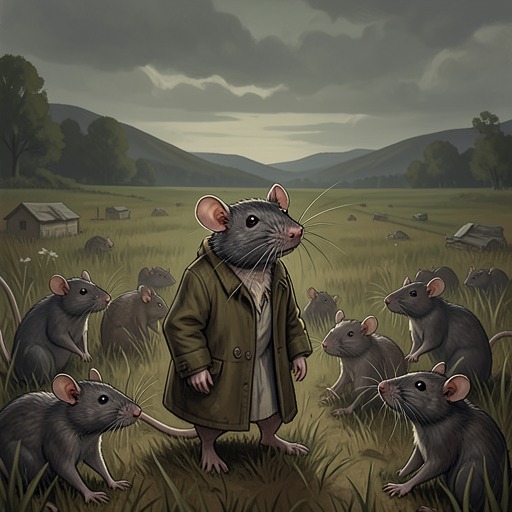
Maurice later explains this vulnerability through the spectacle of rat-coursing. He describes men bringing live rats into a wooden ring and setting terriers among them. Asked whether the rats fought the dogs, he says that they mostly ran around and around. His explanation distinguishes an individual rat, who may think and act bravely, from a crowd of rats overwhelmed by shared fear and panic. In that condition, a group behaves like one large animal with many legs and no brain. Darktan’s recollection of biting a dog on the nose demonstrates individual courage, but it does not disprove Maurice’s point about what fear can do to a crowd.
The contrast gives the change a collective dimension. Intelligence belongs to individuals, but maintaining speech and purposeful action in a crowd requires more than each rat’s isolated capacity to think. Shared fear can undo the habits and identity the rats are trying to build. Their history is therefore not a simple ascent from animality to reason: the changed rats remain vulnerable to the very conditions that can make a group cease to act as a community.
From Changed Rats to the Clan
Darktan later turns that vulnerability around when his squad faces something new underground. Although the young rats are worried, he tells them that they themselves are the new strength: rats with brains, able to think and not to turn and run. He frames the danger through the Book’s Dark Wood and the Bone Rat, a figure associated with those who break, hide, or falter. This appeal does not deny danger; it gives the rats a shared way to face it. Darktan’s leadership makes their changed condition a reason for coordinated action rather than a guarantee that they will feel no fear.
The difference becomes visible when the Clan fights the controlled rats. The Clan enters together, advances in a line, and closes around an enemy that attacks, much like a fist. When fear spreads among the surviving opponents and they try to escape, the formation breaks into pairs that hunt them down. The fighting ends within seconds, and the remaining squeaks disappear into the walls. The scene is a sharp counterpoint to Maurice’s description of rat-coursing: a mass of rats can scatter in panic, but the Clan can also move in formation and respond together. Its coordination is shown in what the rats do, not only in what they call themselves.
Significance
The Change begins as a mystery of exposure and inheritance: the rats eat magical refuse, while Maurice becomes intelligent after eating a rat that had eaten it. It develops into a question of conduct and social form. Maurice’s rule against eating anyone who can talk marks a new moral boundary, and the Clan’s fire, name, and coordinated defense turn that boundary into a shared identity. At the same time, the episodes of panic prevent the transformation from being treated as an uncomplicated escape from animal vulnerability. Speech can fail; fear can dissolve collective judgment. The decisive possibility is not simply that the rats have changed, but that they can learn to act together without surrendering the capacity to think.